

Accounts Payable Automation for Quick Commerce
Quick commerce runs in minutes. Accounts Payable should, too.
In a world where customers expect deliveries in 10 minutes, backend finance operations can’t afford to move at traditional speeds. Yet for many quick commerce businesses, Accounts Payable is still heavily manual, fragmented, and slow. The result? Bottlenecks, payment delays, and constant firefighting.
Intelligent Accounts Payable automation is no longer a “nice to have” for Q-Comm; it’s a necessity.
Why Traditional AP Fails in Quick Commerce?
Quick commerce operates under very different conditions compared to traditional retail or manufacturing, and legacy AP systems simply aren’t built for it.
Here’s where traditional AP breaks down:
When your business moves fast, AP friction becomes a real operational risk.
What Is Intelligent Accounts Payable Automation?
Intelligent Accounts Payable automation goes beyond basic invoice digitization.
It is a touchless, business-driven, and AI-powered system that automatically:
In short, AP shifts from being a back-office cost center to a real-time, decision-ready engine that keeps up with the speed of quick commerce.
Key Features Required in Intelligent AP Automation
a) Flexible 2-Way & 3-Way Matching
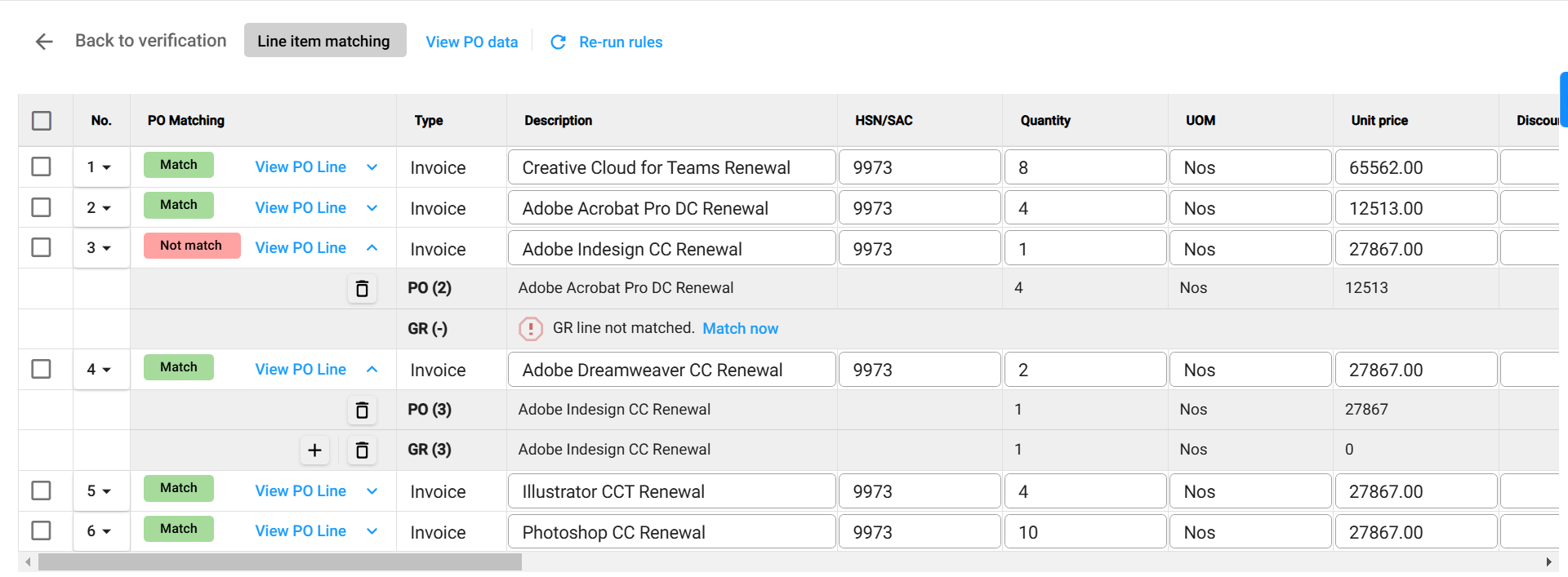
In quick commerce, invoices rarely match POs and GRNs perfectly, and that’s not a failure of the process; it’s the nature of the business.
Quick commerce operates with tight inventory cycles, frequent substitutions, partial deliveries, and suppliers that behave differently across regions and categories. Traditional matching systems, built on rigid and hardcoded logic, struggle in this environment. Even small, acceptable discrepancies can trigger mismatches, leading to unnecessary manual reviews and payment delays.
Business-based 2-way and 3-way matching introduces flexibility without sacrificing control.
With configurable business rules, teams can define matching logic that reflects how their operations actually work:
Example: A supplier delivers packaged snacks worth ₹50,000 daily. The invoice matches the PO value, but no GRN is created due to rapid consumption at the warehouse level.
In this case, the system allows direct invoice approval based on PO match.
Example: A batch of electronics worth ₹5 lakh is delivered against a purchase order of 100 units. However, only 95 units are recorded in the GRN, while the invoice is raised for all 100 units.
In this case, the system identifies the discrepancy and flags a mismatch, allowing payment to be processed only for the 95 units that were actually received, based on the GRN
Example: For fresh produce such as fruits and vegetables, a purchase order is raised for 100 kg of tomatoes. Due to natural spoilage during transit, only 96 kg is recorded in the GRN, while the invoice is submitted for 98 kg.
Since this falls within the predefined ±5% variance threshold, the system accepts the difference and processes the invoice without requiring any manual intervention.
Example: PO raised for Brand A cooking oil (1L packs), and the supplier delivered 70 units of Brand A and 30 units of Brand B (approved substitute). The system accepts substitution based on predefined rules, avoiding rejection.
By aligning matching rules with operational realities, the system significantly reduces false exceptions, improves straight-through processing rates, and accelerates invoice approvals, all while maintaining auditability and compliance.
2) AI-powered PO Matching
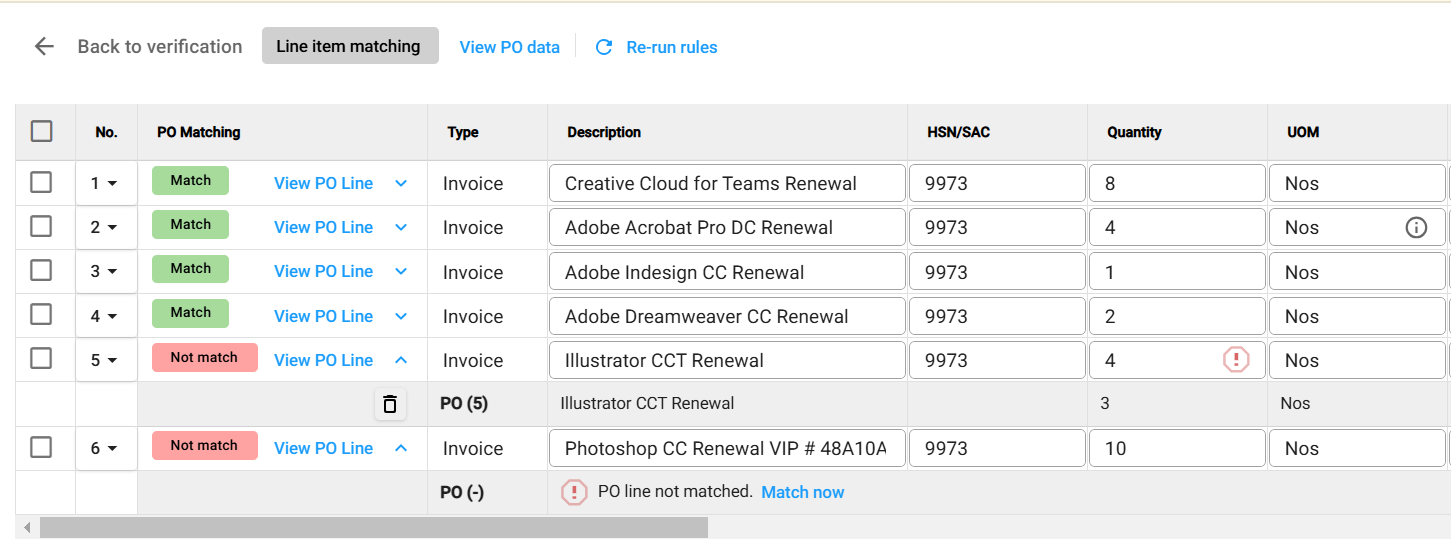
In an ideal scenario, every invoice would reference a single, correct PO, and every PO would be fulfilled exactly as planned. In quick commerce, however, that ideal rarely exists.
Invoices may reference outdated PO numbers, multiple POs, or no PO at all. Deliveries are often split across days or locations, and POs may be partially fulfilled or amended after creation. Managing this level of variability using static, rule-based matching alone becomes complex, slow, and error-prone.
AI-powered PO matching addresses this challenge by using machine learning to understand patterns.
The AI engine analyzes multiple signals simultaneously, including:
Example: A supplier consistently sends 1 invoice for 3 POs and delivers in split shipments, AI will learn this pattern and automatically map invoices to multiple relevant POs.
Example: If Invoice mentions “Sunflower Oil 1L” and PO mentions “SF Oil 1L Refined”,AI will identify semantic similarity and match correctly despite naming differences.
Example: If PO is of 500 units and delivered in 3 batches across 3 days and an invoice is raised for the combined quantity, AI will link all GRNs + PO lines to a single invoice intelligently.
The impact is immediate and measurable:
Over time, the AI continues to learn from outcomes and corrections, making PO matching smarter and more accurate with every invoice processed, which gives a critical advantage for fast-moving, quick commerce businesses.
3) Touchless Invoice Processing
78 From ingestion to Integration, enabling true touchless invoice processing, even for the most complex quick commerce invoices.
Quick commerce invoices are rarely simple. They often span multiple pages, contain hundreds of SKUs, repeat headers on every page, split totals across sections, and use inconsistent layouts depending on the supplier. On top of that, they include Q-Comm-specific fields like MRP, PPC, and carton counts that generic invoice systems fail to recognize reliably.
Once extracted, the data flows seamlessly into validation and matching workflows, where business rules and PO matching logic are applied automatically. Only invoices that genuinely fall outside defined tolerances are flagged for review.
The result is a fully automated, end-to-end invoice journey:
What once took hours of manual review now happens in seconds, allowing AP teams to process high volumes at speed, scale operations effortlessly, and focus only on true exceptions and not on routine invoices.
4) Smart Exception Handling
In quick commerce, volumes are high, and speed is critical, but not every invoice deserves human attention. Smart exception handling ensures that only the invoices that truly matter are flagged, while everything else flows through automatically.
Traditional AP systems generate excessive exceptions because they rely on rigid checks that don’t reflect real-world Q-Comm operations. Minor, acceptable deviations such as small price fluctuations, substitutions, or partial deliveries often trigger alerts, overwhelming AP teams and slowing down the entire process.
Smart exception handling changes this by applying context-aware validations built specifically for quick commerce.
The system evaluates each invoice against Q-Comm-specific business rules, such as:
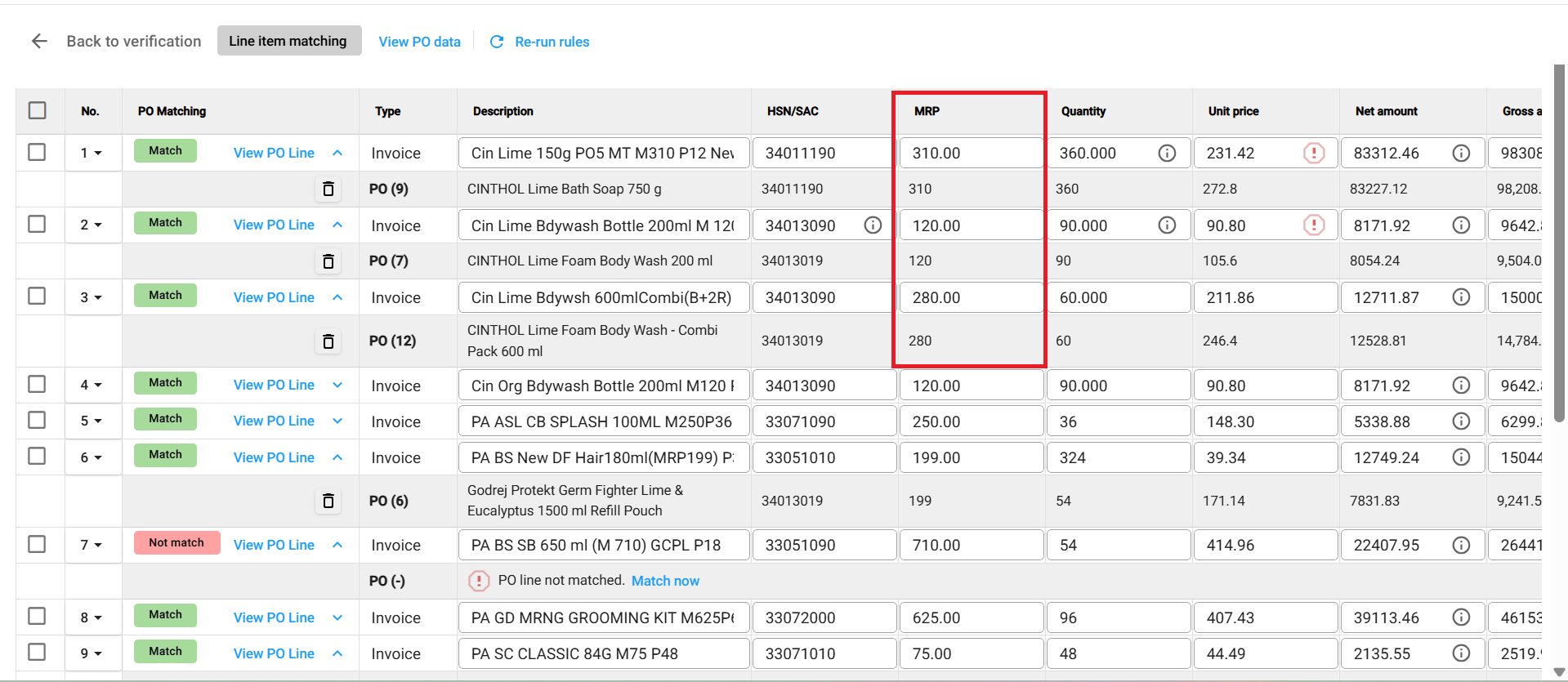
Only when an invoice truly falls outside these defined tolerances does it get flagged as an exception.
When human review is required, the system provides clear, explainable reasons showing exactly which rule failed, by how much, and why the invoice needs attention. This eliminates guesswork, reduces back-and-forth with procurement or suppliers, and speeds up resolution.
The impact is immediate:
Instead of chasing small errors or second-guessing system decisions, AP teams gain confidence in automation, intervening only where judgment truly adds value.
5) Real-Time Dashboard Analytics
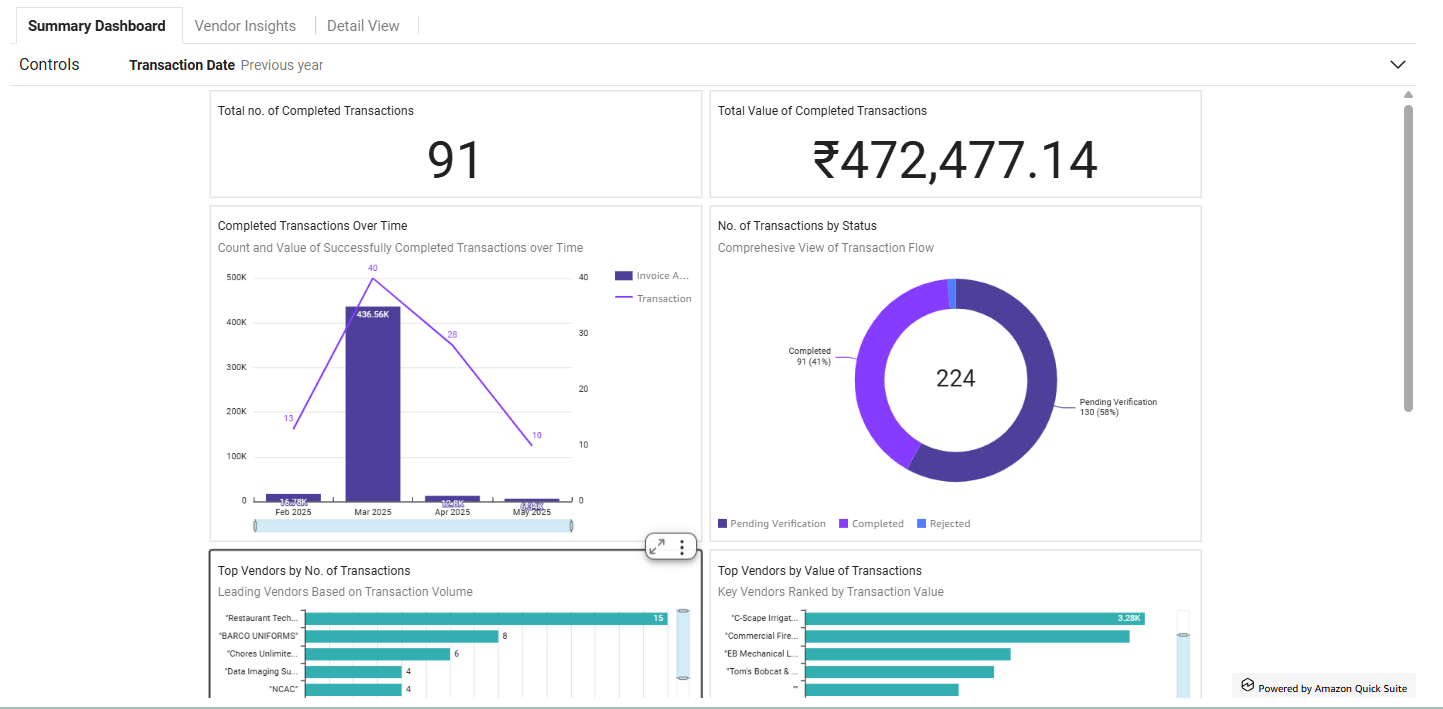
In quick commerce, delayed visibility is as risky as incorrect data. When invoice status, mismatches, or vendor issues surface days later, the damage is already done with stock disruptions, payment delays, and strained supplier relationships.
Real-time AP dashboard analytics eliminate this blind spot by giving finance and operations teams a live,unified view of the entire AP process.
Key insights available in real time include:
Instantly see how many invoices are received, processed touchlessly, pending approval, or stuck in exceptions across locations, suppliers, or time periods.
Track straight through processing rates for 2-way and 3-way matching, identify recurring mismatch patterns, and pinpoint where rules or supplier behavior may need adjustment.
Monitor which suppliers consistently send clean invoices versus those that drive exceptions, delays, or pricing discrepancies, which enable data-backed supplier conversations.
Validate MRP adherence, PPC ranges, and carton-level pricing in real time, helping teams catch non-compliant billing early instead of during audits.
Most importantly, these dashboards serve as a single source of truth for finance, procurement, and operations. Everyone works off the same real-time data, reducing back-and-forth, manual reconciliation, and last-minute escalations.
The outcome is proactive AP management instead of reactive firefighting; it enables faster decisions, tighter control, and complete confidence in what’s being billed, approved, and paid at any given moment.
Frequently Asked Questions (FAQs)
1. Can iAPX integrate with ERP or accounting systems?
Yes. iAPX is designed to seamlessly integrate with leading ERP and accounting systems. Clean, validated invoices are automatically pushed into the ERP for approval, payment processing, and financial posting. The integration ensures real-time data sync, eliminates duplicate data entry, and maintains a consistent audit trail across systems.
2. Is AI used in PO matching?
Yes. iAPX uses AI-powered PO matching to intelligently link invoices with the correct Purchase Orders—even in cases of partial deliveries, split shipments, outdated PO references, or missing PO numbers. The AI engine continuously learns from vendor behavior, SKU-level patterns, and historical corrections to improve match accuracy over time.
3. How does iAPX handle 2-way and 3-way matching?
iAPX supports flexible, business-rule-driven 2-way (Invoice vs PO) and 3-way (Invoice vs PO vs GRN) matching. Organizations can configure SKU-level, category-level, and supplier-level tolerance rules for price, quantity, MRP, PPC, and carton counts. This reduces false mismatches while maintaining compliance and control.
4. Can iAPX process complex quick commerce invoices with hundreds of SKUs?
Yes. iAPX is built to handle multi-page invoices with 200+ line items, repeated headers, split totals, and Q-Comm-specific fields like MRP, PPC, and carton counts. It extracts and validates data accurately without template setup, enabling true touchless processing even for complex invoice formats.
5. How does iAPX reduce manual intervention and exceptions?
iAPX applies context-aware business rules and smart exception handling to flag only genuine discrepancies. Acceptable variances—such as minor price fluctuations, substitutions, or partial deliveries—are automatically processed within defined tolerances. This significantly reduces unnecessary alerts, accelerates approvals, and allows AP teams to focus only on high-value exceptions.


